admin

Canada To Push Back Against Biden's Buy American Pledge

By CBC News | September 17, 2021

The minister responsible for international trade says Canada is well-positioned and ready to push back against a proposed massive new infrastructure bill that strengthens U.S. President Joe Biden’s Buy American pledge.

The U.S. Senate on Monday began debating the $1 trillion USD spending plan, which promises historic investments in everything from the nation’s railways to its electricity grid and high-speed internet network.

But in a worrying development for Ottawa and Canadian companies, the 2,702 page bill would also strengthen laws that call for U.S. tax dollars and government contracts to be spent on American companies as much as possible.

“My pitch to them is that you don’t have a better partner than Canada and that we are on this shared mission in economic recovery together,” said International Trade Minister Mary Ng on CBC’s Power & Politics today.

Ng said work is well underway “to demonstrate how interconnected our supply chains are and how important Canada is” to the U.S. as the Senate begins to debate the bill.

Prime Minister Justin Trudeau also raised concerns with the infrastructure bill during a call with Biden on Monday.

Right now, the bill — which is likely to be amended — says that “taxpayers expect that their public works infrastructure will be produced in the United States by American workers.”

Since taking office earlier this year, Biden has said repeatedly that investments in U.S. companies will ensure a strong recovery from the pandemic and position the U.S. to fend off China and its more quickly growing economy.

A 2019 U.S. government report stated that of the $290 billion in contracts the U.S. government issued in 2015, Canadian firms got contracts worth about $674 million.
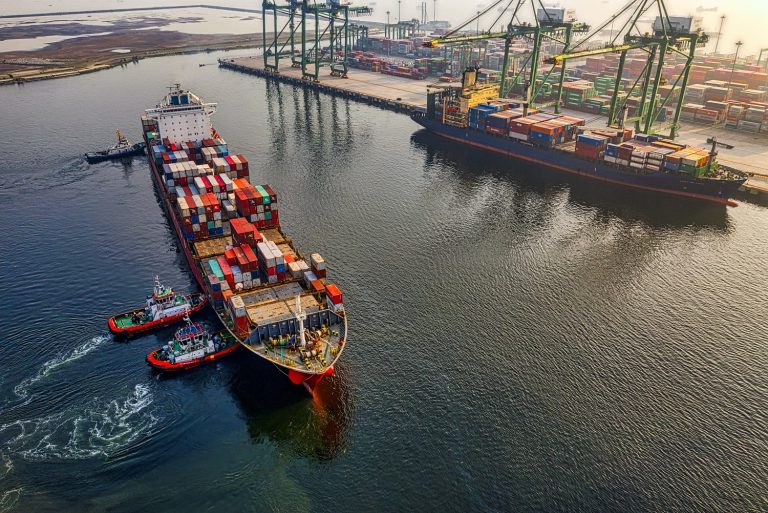


global supply chains are being battered by fresh covid surges

By GCaptain | September 14, 2021

Asia’s renewed surge in Covid-19 infections is compounding supply-chain blockages across the world’s biggest source of manufactured goods.  After weathering earlier pandemic waves better than other regions, the fast-spreading delta variant has thrown into turmoil factories and ports in countries that were once among the most successful containing the virus.

The snarls in Asia — where the United Nations estimates around 42% of global exports are sourced — risk twisting their way through global supply chains just as shipments would usually ramp up for the Christmas holiday shopping season.  As earlier snags have shown, problems that start in Asian ports can ripple slowly, showing up later as delays in places like Los Angeles or Rotterdam and higher prices for consumers.  The flare-ups also worsen an already tortured year for exporters, with shipping costs sky-high due to a shortage of containers and as raw materials such as semiconductors become pricier and difficult to source amid red-hot demand.

“Delta is likely to significantly disrupt trade in Asia,” said Deborah Elms, executive director of the Singapore-based Asian Trade Centre. “Most of the markets have been fortunate in managing Covid well so far. But as Covid continues to spread, this lucky streak is likely to end for many locations.”

In a sign of those concerns, oil prices extended declines at this week’s opening in Asia as the delta variant’s spread has undermined the outlook for global demand.  In China, the world’s third-busiest container port was partly shut recently, while in Southeast Asia — among the worst-hit regions — factory executives have stalled production of electronics, garments and scores of other products.  At stake is an export boom that shielded trade-driven economies during the pandemic and was expected to fuel a broader rebound. The World Trade Organization had forecast Asia to lead an 8% rise this year in global goods trade.  Meanwhile, the supply choke will fuel concerns that rising inflation for Chinese producers or U.S. consumers will prove more than transitory, testing expectations among policymakers for a near-term cooling in prices.

The delta variant — as contagious as chickenpox — infiltrated China’s tough border defenses, seeding the first cases for months in places like Beijing and Wuhan. Indonesia is leading Southeast Asia in cases and deaths, pushing the region toward being among the worst-hit globally as vaccination rollouts lag. While China’s cases are relatively low, its zero-tolerance approach has ensnared the Meishan terminal in Ningbo-Zhoushan port, where all inbound and outbound container services were halted Wednesday after a worker became infected.  That shutdown follows the closure of Yantian port in Shenzhen for about a month after a small outbreak, which had ripple effects for international shipping.  In Southeast Asia, manufacturing managers saw a slump in activity last month as critical exporters struggled to keep factories running, a sign that Covid might finally be making a dent in the region’s resilient trade.

While Indonesia, Malaysia, the Philippines, Vietnam and Thailand account for a combined 5.7% of global exports, they can greatly impact bigger economies like the U.S. and China, particularly in electronics, according to estimates by Natixis. China imports 38% of its data processing machines and 29% of its telecommunication equipment from the five countries, while the U.S. depends on half its semiconductor imports from the bloc.  That extends to export hubs of Japan and South Korea, which have remained mostly on track. Samsung Electronics Co., for instance, last month said revenues in its mobile phone business have been hit by the outbreak in Vietnam.


ships divert from ningbo, no timeframe given for terminal reopening

By Splash247 | August 18, 2021

Having learned lessons from the closure of Yantian Port earlier in the summer, a number of carriers are not hanging around waiting for Ningbo Meishan Island Container Terminal to open anytime soon, with several ships opting to skip Ningbo this week.

One port worker at the terminal was found to have contracted Covid-19 yesterday, resulting in the terminal being closed. Tests on the port’s workforce are underway, and the terminal is being decontaminated. For all other Ningbo terminals, the gate-in of export containers is now limited to two days of a vessel’s expected time of arrival.

It seems the whole Meishan terminal is closed until further notice. All the shipping agents are running around trying to change to Shanghai,” one well placed source told Splash today.

There has been no official announcement yet on how long the terminal will be closed. The outbreak at Yantian in eastern Shenzhen in late May resulted in a partial lockdown lasting four weeks.

The sheer enormity of Ningbo-Zhoushan port, the world’s largest port in tonnage terms, appears to have helped prevent a wider total port lockdown. Meishan Island is approximately 30 km away from Ningbo’s major container terminal at Beilun, and 60 km away from Ningbo downtown.

Meishan accounts for approximately 20% of the near 30m teu that pass through the port each year. There are currently a total of 41 container services calling Meishan, eight into North America, six for Europe, and two for the Red Sea. The Meishan closure mainly impacts the Ocean Alliance, a grouping made up of Cosco, OOCL, CMA CGM and Evergreen. 

Cosco and CMA CGM have already indicated that a number of ships will skip Ningbo this week. The Covid closure comes at a time where both Ningbo and Shanghai had been experiencing severe congestion, the worst in the world, over the past two weeks. Data provided by MarineTraffic today shows the unprecedented volume of ships waiting for berth space to open up at Ningbo today.

Clients should expect further delays and congestion amidst these issues.


u.s. ports face peak-season as anchorages fill

By Freight Waves | August 04, 2021

The fear voiced by Port of Los Angeles Executive Director Gene Seroka earlier this year was that “we will still have vessels at anchor come midsummer,” when terminals pivot to handling the peak season rush starting around August 1.

It is now midsummer. There are still vessels at anchor — a lot of them.

Logistics consultant Jon Monroe warned Thursday, “Now we have a myriad of charter carriers all introducing vessels into a China-Pacific Southwest service at the same time the large carriers are adding extra loaders. Expect the West Coast to be slammed the entire month of August. We are entering gridlock plus.”

The number of container ships at anchor in San Pedro Bay off the ports of Los Angeles and Long Beach rose back to 30 on July 23. There were 27 at anchor on Friday.

The all-time record — 40 — was set on February 1. Beginning in mid-March, San Pedro Bay anchorage numbers gradually declined as ship arrivals were curbed, both intentionally by carriers to get schedules back on track and unintentionally because their ships fell too far behind. 

The 2021 low — nine container ships at anchor in San Pedro Bay — was hit on June 18, as fallout from the port closure in Yantian, China, further pared arrivals.

The following day was the turning point. On June 19, the total number of ships in the complex (at berths in Los Angeles and Long Beach, and at anchor) fell to 30. It hadn’t been that low since mid-October, when the anchorages first started to fill.

After June 19, the respite ended. Delayed Yantian cargo started to arrive. Import demand heading into peak season brought more ships. Between June 19 and Friday, the total number of ships in the complex increased 80% and the number of ships at anchor jumped 170%.

The data confirms that more ships calling in Los Angeles/Long Beach (both at berth and anchor) equate to a higher percentage of ships at anchor. Since the trend reversed on June 19, the share of ships at anchor versus the total has risen back up to 45%-55%, moving in the direction of the 60%-65% peak seen in the first quarter.

Altogether, around 80 container ships are awaiting berths at ports on all three U.S. coastlines. And peak season is now set to begin in earnest, implying even more congestion ahead.


eu unveils new climate rules, including tax on foreign polluters

By CBC News | July 19, 2021

European Union policy-makers have unveiled their most ambitious plan yet to tackle climate change, aiming to turn green goals into concrete action this decade, and in doing so lead the way for the world’s other big economies.

The European Commission, the EU executive body, set out how the bloc’s 27 countries can meet their collective goal to reduce net greenhouse gas emissions by 55 per cent from 1990 levels by 2030 — a step toward “net zero” emissions by 2050.

This will mean raising the cost of emitting carbon for heating, transport and manufacturing, taxing high-carbon aviation fuel and shipping fuel that have not been taxed before, and charging importers at the border for the carbon emitted in making products such as cement, steel and aluminum abroad. It will consign the internal combustion engine to history.

The “Fit for 55” measures will require approval by member states and the European parliament, a process that could take two years.

They are also likely to face intense lobbying from some industrial sectors, from poorer European member states that want to protect their citizens from price rises, and from more polluting countries facing a costly transition.

The EU produces only eight per cent of global emissions, but hopes its example will elicit ambitious action from the world’s other major economies when they meet in November in Glasgow for the next milestone UN climate conference. 

Ships must pay for carbon now, too

Tighter emission limits for cars will in effect end new petrol and diesel car sales in the EU by 2035 — the earliest of the possible dates that had been touted.

An overhaul of the EU Emissions Trading System, the biggest carbon market in the world, will force factories, power plants and airlines to pay more when they emit CO2. Ships will also be added to the ETS, requiring ship owners to pay for their pollution for the first time.

A new EU carbon market will impose CO2 costs on the transport and construction sectors — with some of the revenues put in a fund to curb low-income households’ fuel bills.

The Commission also unveiled its plan for the world’s first carbon border tariff, requiring manufacturers abroad to pay for the CO2 they have produced when they sell goods such as steel and cement into the EU.

Tax on jet fuel

Meanwhile, a tax overhaul will impose an EU-wide tax on polluting aviation fuels, which currently dodge such levies.

EU member states will also be required to build up forests and grasslands — the carbon sinks that keep carbon dioxide out of the atmosphere.

For some EU countries, the package is a chance to cement the EU’s global leadership in fighting climate change, and to be at the forefront of those developing the technologies needed. 

Poorer member states are wary of policies that will raise costs for the consumer, while regions that depend on coal-fired power plants and mines want guarantees of more support for a transformation that will cause dislocation and require mass retraining


Box Rates Up 332% Year Over Year

By Splash247 | July 07, 2021

Shippers might be paying 332% more per box that they were this time last year, according to the latest data from Drewry, yet they’re having to put up with the worst schedule reliability in the history of the shipping container industry.

In the first five months of 2021, 401 vessel arrivals on the transpacific and 144 on Asia-Europe were over 14 days late, according to data from Sea-Intelligence. Putting these numbers in perspective, the combined 2012 to 2020 total of such late vessel arrivals was 388 on the transpacific and 69 on Asia-Europe.

“In the past few months, schedule reliability has been largely consistent, albeit at an extremely low level of 35%-40%, compared to a long-term average of around 75%,” Sea-Intelligence noted in its most recent weekly report.

The average delay for vessel arrivals that were marked as late remains extremely high globally, at close to six days, compared to a long-term average of around four days.

Liners have gone public recently, admitting that the current late arrivals situation is not good enough.

Earlier this month Hapag-Lloyd launched an initiative to provide full transparency on its schedule reliability.

“We are fully aware that our industry is currently facing the worst operational crisis in more than a decade and that we are far from delivering the absolute levels of service that you would expect from us and the entire industry,” the German carrier stated in a note to clients.


Container Rates Continue To Skyrocket

By American Shipper | June 14, 2021

The sharp upward increase in container freight rates appears to have no end in sight, much to the alarm of shippers.

Delays, congestion and container availability problems are increasing at ports and terminals, largely due to the continued impacts of COVID-19.

While premium charges on top of spot rates are now so high that index rates are no longer able to capture the true cost of ocean shipping, here are approximate rate jumps for the following regions:

Asia-East Coast

The Freightos Baltic Daily Index for Asia-East Coast surged by around 20% in just the past few days. As of June 10, the Freightos rate reached $9,317 per FEU, its highest point ever and up 224% year on year (y/y).

The Drewry weekly assessment for the Shanghai-New York route was $8,251 per FEU, up 9% week on week (w/w) and 203% y/y.

S&P Global Platts provides daily assessments of Freight All Kinds (FAK) rates. Its North Asia-East Coast FAK assessment, as of Thursday, was $6,800 per FEU, up 152% y/y.

Asia-West Coast

Freightos put Thursday’s Asia-West Coast spot rate at a record-high $6,341 per FEU, up 194% y/y. Drewry’s weekly Shanghai-Los Angeles index is at $6,313 per FEU, up 6% w/w and 199% y/y.

S&P Global Platts’ North Asia-West Coast North America FAK rate was $4,200 per FEU on Thursday, almost triple the FAK rate a year ago.

Asia-East Coast

Asia-East Coast rates have been rising faster than Asia-West Coast rates, according to Freightos’ data.

Freightos’ East Coast-West Coast spread — the premium importers pay to take the long route via the Panama Canal — hit $2,976 per FEU on Thursday, a record high. It has spiked in recent days.

Trans-Atlantic Westbound

Freightos’ Europe-East Coast assessment for Thursday was $5,193 per FEU, a new record and up 164% y/y. 

Underscoring how different indexes come up with different figures, Drewry’s number is much lower than Freightos’. Drewry put Rotterdam-New York rates at $3,988 per FEU, up 66% y/y.

Trans-Pacific

Rates for U.S. exports out of the West Coast to Asia have also jumped, albeit off a far lower base. Freightos assessed rates on this route at $1,208 per FEU on Thursday, up 154% y/y.

Drewry’s weekly rate is lower: $808 per FEU, up 61% y/y.