NEWS

Amazon Invests €10 Billion in European Warehouse Robotics

By JiuFang Logistics
July 24, 2026

European Warehouse Investment

Amazon announced on June 4 that it will invest more than €10 billion to expand and modernize fulfillment centers across Europe. The program combines additional warehouse capacity with robotics designed to move inventory and handle repetitive tasks.

Amazon also plans to add 25,000 fulfillment center jobs in Europe over the coming years. The company said the investment will support employees while improving warehouse operations and delivery speed.

New Proteus Robot

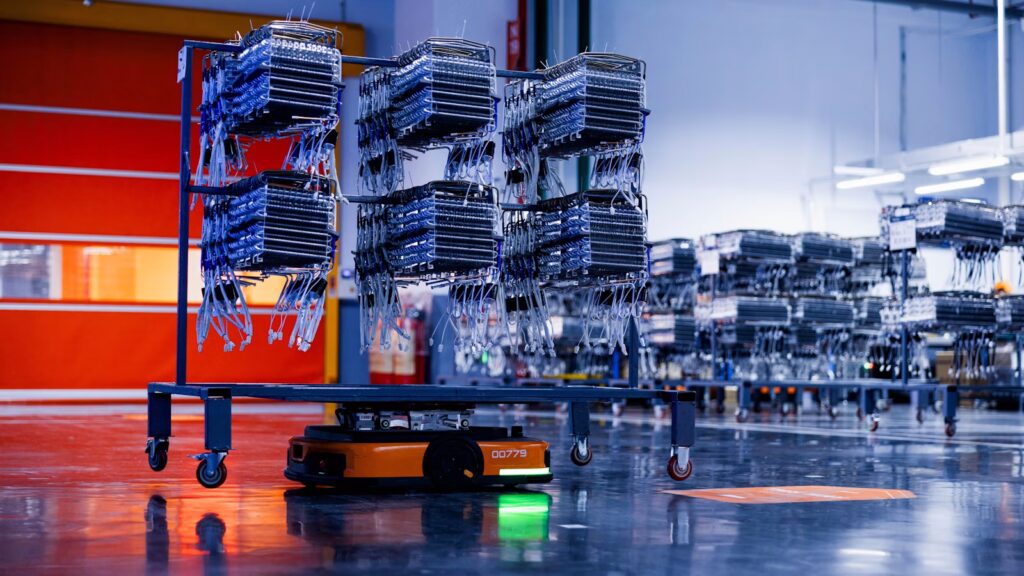
The next generation of Amazon’s autonomous Proteus robot can operate beyond loading-dock areas and move items across fulfillment sites. Employees can direct it with conversational text prompts instead of technical commands.

Amazon said Proteus can determine the route, priority and timing for assigned work. It is currently being piloted in Amazon laboratories, with European deployment planned for the first half of 2027.

STARK Expansion

The investment also includes STARK, a robotic tote-handling system that picks full storage bins from conveyors and places them on carts. After an initial pilot in Barcelona, Amazon plans to expand STARK to 15 European sites by 2027.

Amazon will also widen the use of Vulcan, its warehouse robot with a sense of touch. These systems focus on internal handling after inventory has entered the fulfillment network.

Impact on FBA Sellers Shipping from China

More automation may increase the speed and consistency of inventory movement inside an Amazon FBA warehouse, but the announcement does not change seller inbound requirements. China-based sellers still need to follow the shipment plan, labeling, carton, pallet and delivery-appointment rules shown in Seller Central.

Sellers should not route cargo to a warehouse based only on news of an upgrade. Amazon assigns the destination when the inbound shipment is created. For European inventory, customs clearance, VAT arrangements and delivery to the assigned fulfillment center remain separate steps before Amazon can receive the stock.


Sources


UK Publishes CBAM Rules for China Exporters Ahead of 2027

By JiuFang Logistics
July 23, 2026

UK CBAM Policy Update

The UK government published an updated Carbon Border Adjustment Mechanism policy summary on July 16. The document follows secondary regulations laid on July 13 and gives importers and overseas manufacturers more detail on registration, returns, record-keeping, carbon price relief and CBAM rate calculations.

The UK CBAM will start on January 1, 2027. It is separate from the EU CBAM and will apply across the United Kingdom, including Northern Ireland.

Products and Importers in Scope

The mechanism covers specified commodity codes in aluminium, cement, fertiliser, hydrogen, iron and steel. Some products, including identified aluminium and iron or steel scrap codes, are excluded at launch.

The person named as the importer on the customs declaration is generally liable for CBAM. A minimum registration threshold of £50,000 applies to the value of relevant CBAM goods. Importers can appoint tax agents to submit returns, but the tax agent does not assume the liability.

How the CBAM Charge Is Calculated

The CBAM charge is based on imported embodied emissions multiplied by the applicable CBAM rate. Eligible carbon price relief can then reduce the final liability when an effective carbon price has already been paid.

Importers may use verified actual emissions data or UK government default values. Actual data must come from the producer and be verified by a qualifying verifier. Weight, emissions intensity and supporting records will therefore become part of the commercial information needed for covered imports.

What China Exporters Should Prepare

Chinese manufacturers selling covered goods to the UK should confirm commodity codes, non-preferential origin and product weight before shipping. They should also determine whether they can provide verified facility-level emissions data to the UK importer.

Shipping documents alone will not establish the carbon liability. Exporters, importers, customs brokers and logistics providers need consistent product and weight data, while the manufacturer and verifier supply the emissions evidence. Using default values may be simpler, but it can weaken price competitiveness if the defaults exceed the producer’s actual emissions.

Sources


Daily CBAM Cost Index Gives China Exporters Earlier Price Signals

By JiuFang Logistics
July 23, 2026

Fastmarkets Launches Daily CBAM Assessments

London-based Fastmarkets announced two daily price assessments for EU Carbon Border Adjustment Mechanism certificates in June. The tools are intended to give importers and exporters an earlier view of carbon costs while goods are being priced and traded.

Under the current EU CBAM framework, official certificate costs are confirmed after each reporting period: quarterly in 2026 and weekly from 2027. That delay can leave companies exposed to a changing cost after commercial terms have already been agreed.

How the Two Indexes Work

The CBAM Certificate Index is published daily in euros per tonne of carbon dioxide equivalent. It combines auctioned EU Allowance values with spot and forward allowance prices to estimate the certificate cost at the end of the reporting period.

The CBAM Certificate Builder tracks the volume-weighted average cost of EU Allowance auctions completed within the current reporting period. Fastmarkets said both series are designed to converge with the official CBAM certificate price when the period closes.

Impact on China-EU Trade

EU importers must purchase certificates covering the embedded emissions of goods within CBAM scope. Chinese exporters do not normally buy the certificates, but their production emissions influence the importer’s cost and can affect negotiations for steel, aluminium, cement and other covered products.

A daily cost signal allows buyers and sellers to state which carbon-price assumption applies to a quotation. It can also reduce disputes when the official certificate price is confirmed after the shipment has departed.

Data Needed Before Shipping

China exporters should provide the correct commodity code, product weight and installation-level emissions information before cargo leaves origin. The Fastmarkets tools can use either EU default values or verified emissions data, but the chosen basis should be clear in the sales contract.

CBAM compliance remains separate from freight charges and customs duty. Logistics teams should keep shipment quantities and customs records aligned with the emissions data used by the EU importer, while commercial teams price the carbon exposure separately.

Sources


Walmart Price Cuts Add Cost Pressure for China-to-USA Sellers

By JiuFang Logistics
July 7, 2026

What Happened

Walmart announced broad price cuts in the United States on July 6, covering thousands of items across grocery, household goods, toys, apparel and seasonal products. Associated Press reported that Walmart and Sam’s Club described the rollbacks as a summer-season move for customers.

The Wall Street Journal reported that the cuts include lower prices on ground beef, cherries, Coca-Cola and other products, and that Walmart has emphasized cost-control policies such as lower tariffs and fuel prices when discussing affordability with federal officials.

Why It Matters for China-to-USA Shipping

Walmart’s pricing moves matter for China-to-USA ecommerce and import suppliers because the retailer sells high volumes of household goods, toys, apparel and seasonal products. Lower retail prices can raise pressure on suppliers and marketplace sellers to protect margins while keeping inventory available.

For China-origin goods, landed cost becomes more important. Freight rates, customs duties, storage fees and last-mile costs all affect whether sellers can support lower shelf prices without losing margin.

Seller Impact

China-based suppliers and Walmart marketplace sellers should review pricing, replenishment timing and fulfillment capacity. Fast-moving discounted products may need earlier booking, split shipments or US-based inventory to avoid stockouts.

Accurate customs documentation also matters. Delays at clearance can reduce the benefit of a promotion if goods arrive after demand peaks or miss seasonal sales windows.

Shipping Outlook

Walmart’s price cuts are not a shipping rule change, but they are a demand and margin signal. Sellers shipping from China to the United States should focus on predictable transit, clean import data and tighter landed-cost planning.

Sources


Amazon Australia Prime Day Extends China-to-Australia Ecommerce Demand

By JiuFang Logistics
July 6, 2026

What Happened

Amazon Australia Prime Day 2026 starts on July 7 and runs through July 13, making it a seven-day sales event. TechRadar reported on July 3 that early deals were already available before the official start.

The event covers categories including electronics, home appliances, beauty, fashion and Amazon devices. Getprice reported that Amazon Australia offers more than 200 million products across more than 30 categories.

Why It Matters for China-to-Australia Shipping

A longer Amazon sale window can stretch demand for ecommerce inventory, especially for sellers sourcing from China. Products tied to tech accessories, home goods, fashion and small appliances often depend on predictable cross-border replenishment before and during major marketplace events.

For China-based exporters and Amazon sellers, the key logistics pressure is timing. Inventory that misses the pre-sale window can lose ranking, sales velocity and delivery reliability during peak traffic.

Amazon Seller Impact

Sellers shipping from China to Australia should review stock levels, transit times and last-mile delivery promises. Fast-moving Prime Day items may need earlier replenishment, split shipments or local fulfillment to avoid stockouts during the seven-day promotion.

The extended event also increases the importance of accurate customs data and product classification. Delays at clearance can reduce the value of promotional pricing if goods arrive after demand peaks.

Outlook

Amazon Australia’s longer Prime Day points to stronger mid-year competition in ecommerce. For China-to-Australia sellers, the practical response is tighter inventory planning, earlier shipment scheduling and more reliable fulfillment support.

Sources


CPSC Recalls Multiple China-Made Products Sold on Amazon

By JiuFang Logistics
July 3, 2026

What Happened

The U.S. Consumer Product Safety Commission issued several July 2, 2026 recalls and safety warnings involving China-made consumer products sold through Amazon or other U.S. e-commerce channels.

The products covered toys with accessible button cell batteries, nursing pillows, baby loungers, lithium coin batteries and pool drain ports. The cases show that product safety documentation is now a core issue for cross-border e-commerce, not only a post-sale customer service issue.

Amazon Products Named by CPSC

CPSC recalled about 62,490 POPOOO Jungle Safari LED Finger Lights sold on Amazon because children could access button cell batteries. The retailer was Shenzhen Bopu Product Design Co., Ltd., dba POPOOO, of China.

CPSC also recalled 4,008 AMASKY Nursing Pillows sold on Amazon by Xishentang Dongguan Trading Co., Ltd., dba Pretty-Life, of China. The products violated mandatory standards for nursing pillows and infant support cushions.

Junpower CR2032 lithium coin batteries sold on Amazon by JSNJ_Tech Store were recalled because the packaging was not child-resistant and lacked required warnings under Reese’s Law. The importer was Changzhou Niujie Battery Technology Co., Ltd., dba JSNJ_Tech, of China.

Other July 2 actions included VEVOR baby loungers sold on VEVOR.com, Amazon.com and Wayfair.com, and Topyond pool drain ports sold on Amazon by Changsha Jiali Duo Technology Co., Ltd., dba Topyond, of China.

Why It Matters for China-Based Sellers

China-based sellers shipping to Amazon FBA, U.S. private warehouses or direct U.S. customers should treat CPSC compliance as part of the shipment planning process. Regulated products can face recalls, listing removals, refunds, platform enforcement and customs delays if safety records are missing or inaccurate.

High-risk categories include toys, children’s products, infant sleep products, button or coin batteries, lithium battery goods and pool or outdoor safety products.

Shipping and Compliance Actions

Before shipping from China to the United States, sellers should confirm whether each SKU needs a Children’s Product Certificate, General Certificate of Conformity, test report, tracking label, warning label, battery packaging documentation or other safety file.

Freight planning should include compliance checks before cargo leaves China. Sellers should align product data, HS codes, supplier records, test reports and Amazon compliance submissions before booking air freight, ocean freight, Amazon FBA replenishment or small parcel delivery.

Sources


Amazon to Show Import Charges as EU €3 Parcel Fee Begins

By JiuFang Logistics
July 2, 2026

What Happened

The European Union started a €3 fee on low-value e-commerce parcels imported from China on July 1, 2026, according to Reuters. The fee applies to parcels that previously entered the EU duty-free under the €150 low-value import threshold.

Reuters reported that the EU recorded 5.8 billion sub-€150 e-commerce shipments in 2025, up from 1.4 billion in 2022, with the surge linked to platforms and sellers using direct-to-consumer parcel shipping from China.

Amazon's Response

Amazon, which launched Amazon Haul as a low-cost shopping service to compete with Shein and Temu, said 97% of its EU shipments last year were fulfilled from warehouses inside the bloc, according to Reuters.

For products shipped from outside the EU, Amazon said customers would be shown import charges before checkout. This makes landed cost more visible to buyers before they complete a purchase.

Why It Matters for China-Based Amazon Sellers

China-based sellers using Amazon Europe should review whether their products are fulfilled locally in the EU or shipped directly from China or another non-EU country. Products shipped from outside the EU may become less competitive if import charges are shown during checkout.

The change affects pricing, conversion rate, margin planning and delivery promises for low-value products. Sellers should also review HS codes, product descriptions, declared values, VAT handling and IOSS-related data.

FBA and FBM Fulfillment Actions

Amazon sellers should compare direct FBM parcel shipping with bulk replenishment to Amazon FBA Europe or local EU warehouses. For repeat-selling SKUs, local stock can reduce checkout friction and avoid parcel-level import charges being shown to customers at delivery or checkout.

For urgent inventory, sellers may still use air freight from China to Europe. For stable-demand SKUs, ocean freight or consolidated air freight to EU fulfillment centers may lower per-unit logistics cost and improve delivery reliability.

Sources


EU €3 Duty Starts on Low-Value E-commerce Parcels from July 1

By JiuFang Logistics
July 1, 2026

What Happened

The European Union starts a temporary €3 customs duty on low-value parcels imported from outside the EU on July 1, 2026. The measure applies to e-commerce goods worth up to €150, including common online categories such as clothing, toys, electronics and other consumer goods.

The European Commission says the change is intended to improve fairness and safety in a market where millions of low-value parcels enter the EU every day.

How the New Duty Works

The €3 duty applies per item based on tariff classification, not simply per package. The temporary duty is scheduled to remain in place until July 1, 2028, when the EU’s broader customs reform is expected to replace it with normal customs duties by product type.

Reuters also reported that France is suspending its separate €2 charge on low-value packages from outside the EU as the EU-wide fee begins. A further EU administration fee is expected to raise the total charge to €5 from November.

Why It Matters for China E-commerce Sellers

The rule directly affects China-based sellers and platforms using direct parcel shipping into Europe, including business models similar to Shein, Temu and AliExpress. Low-value parcel economics will change because duty now becomes part of the landed-cost calculation.

Sellers that previously priced EU orders around duty-free direct shipping should review product margins, checkout pricing, VAT handling, customs data and return policies.

Shipping and Fulfillment Impact

Direct small parcel shipping may remain workable for some products, but the new duty increases the importance of correct HS codes, product descriptions, declared values and IOSS-related data.

For repeat-selling SKUs, China-based sellers should compare direct parcel delivery with bulk replenishment to EU warehouses, Amazon FBA Europe or third-party fulfillment centers. Consolidated air freight or ocean freight may reduce per-unit logistics pressure when parcel-level duty and handling costs rise.

Sources


U.S. Retailers Frontload China Orders Ahead of Holiday Season

By JiuFang Logistics
June 30, 2026

What Happened

U.S. retailers are bringing forward orders from China by four to six weeks to secure inventory for Black Friday and Christmas before possible tariff changes later this year, according to Reuters reporting on June 30.

Shipping executives told Reuters that China-to-U.S. volumes in May and June were higher than expected. The usual July-to-September holiday shipping peak has started earlier as retailers move inventory ahead of potential cost increases.

China-to-U.S. Shipping Rates Rise

Drewry’s World Container Index for June 25 showed spot rates from Shanghai to New York rising 6% to USD 7,149 per 40-foot container, while Shanghai to Los Angeles increased 12% to USD 5,750 per 40-foot container.

Drewry said importers continued frontloading shipments ahead of possible tariff changes and higher bunker-related costs. It also noted tight Transpacific capacity and expected rates to rise further in the coming weeks.

Why Retailers Are Moving Earlier

Reuters reported that U.S. retailers are responding to tariff uncertainty, holiday inventory needs and tighter vessel space. Key China-origin exports in May included smartphones, lithium-ion batteries, solid-state drives, toys, kitchenware and festival products.

Early orders also included back-to-school goods, Christmas inventory and soccer World Cup-related products such as jerseys, flags, souvenirs and large-screen TVs.

What China Exporters Should Do

Exporters and e-commerce sellers shipping from China to the United States should book space earlier, review landed-cost assumptions and separate urgent replenishment from bulk inventory.

Amazon FBA, Walmart WFS, Shopify and private-warehouse sellers should check inventory deadlines, choose between air and ocean based on stockout risk, and confirm whether peak season surcharges affect current quotes before booking shipments.

Sources


Prime Day 2026 U.S. Online Spending Tops $26.4 Billion

By JiuFang Logistics
June 29, 2026

What Happened

U.S. shoppers spent more than USD 26.4 billion online during Amazon Prime Day 2026, according to Reuters reporting based on Adobe Analytics data. The June 23-26 event grew 9.3% from the previous year and exceeded Adobe’s earlier forecast of USD 26.3 billion.

The four-day event also overlapped with competing promotions from major U.S. retailers, turning the period into a wider online discount cycle beyond Amazon alone.

Products and Sales Channels

Reuters reported that strong discounts helped drive purchases of electronics, toys, appliances and personal care items. At the same time, shoppers remained price-sensitive, with many consumers focusing on essentials, back-to-school goods and value-driven purchases.

The data shows that U.S. online demand remains strong during major sale periods, but conversion depends heavily on discounts, inventory availability and delivery confidence.

Why It Matters for China-Based Sellers

For China-based sellers on Amazon, Walmart Marketplace, Shopify and other U.S. e-commerce channels, Prime Day performance is a direct signal for inventory planning. Strong traffic can quickly expose weak SKU-level stock, slow inbound shipments, poor pricing and limited local fulfillment capacity.

Sellers that rely only on late direct shipping from China may miss peak demand windows. Sellers with inventory already positioned in Amazon FBA, Walmart WFS, U.S. overseas warehouses or private warehouses are better placed to capture short promotion cycles.

FBA and Warehouse Replenishment Actions

After Prime Day, sellers should review sell-through by SKU, check remaining FBA and warehouse stock, and decide whether urgent replenishment requires air freight or express shipping from China.

For stable-demand SKUs, ocean freight to Amazon FBA, Walmart WFS or U.S. overseas warehouses can help reduce per-unit logistics cost. Sellers should also plan for returns, back-to-school demand and holiday-season inventory before confirming new production or freight bookings.

Sources